“Man is born free and everywhere he is in chains.” Rousseau’s statement in The Social Contract has perhaps never resonated as much with people as it does today. In Western civilization, slavery is eradicated. Being born free is constitutionally recognized and mandated, and yet many facets of our lives and our so-called modern democracies enchain us. The real question is, why do we allow this?
The relationship between people and the State has long animated Western discourse. It was explored as early as the 4th century B.C. by Socrates, who accepted his imprisonment and death penalty. To Socrates, he had an obligation to obey the laws of Athens, which had once facilitated different aspects of his life. According to Socrates, there is an implicit contract between citizens and the State. By choosing to stay in a State and benefitting from its laws and protections, citizens acquire an equal obligation to the State. Thomas Hobbes was one of the early proponents of the social contract theory. Hobbes recognized that since people are reasonable, they can escape the State of Nature to create a civil society by adopting a social contract where they collectively renounce their rights against each other and imbue another person with the authority and power to enforce the initial contract. According to John Locke, once the government fails to protect people’s property and well-being or it becomes tyrannical, the people have a right to resist the State’s authority because the initial social contract has been broken. According to Rousseau, people part with their natural rights for the creation of the State, which guarantees the equality and liberty of all citizens.[i]
Perhaps you read this and believe that these are only theories. The logical implication of that is to question why we would be bound by them? The truth is we are not, but our human civilization requires accepting some basic premises, and these theories have proven themselves throughout history time and time again. The American Revolution, which rejected British imperial rule, was ultimately colonial opposition to taxation without representation in the British Parliament. When the French Third Estate, the only order paying taxes, was no longer represented by King Louis XVI, they rebelled because the social contract had been broken. The Russian Revolution and the end of the Romanov rule were ultimately the results of Russian workers struggling because of the impoverished state of their country. All of these events profoundly shaped world history for centuries to come.
The time of absolute monarchs and tyrants is supposedly over. Our modern Western democracies have given power to the people, and yet, while we have run from the tyrants of the past, we have once again created tyrants through the guise of democratically elected leaders. Abetted by technological advances, we have given these tyrants greater powers of control than anything that would have been possible in the past.
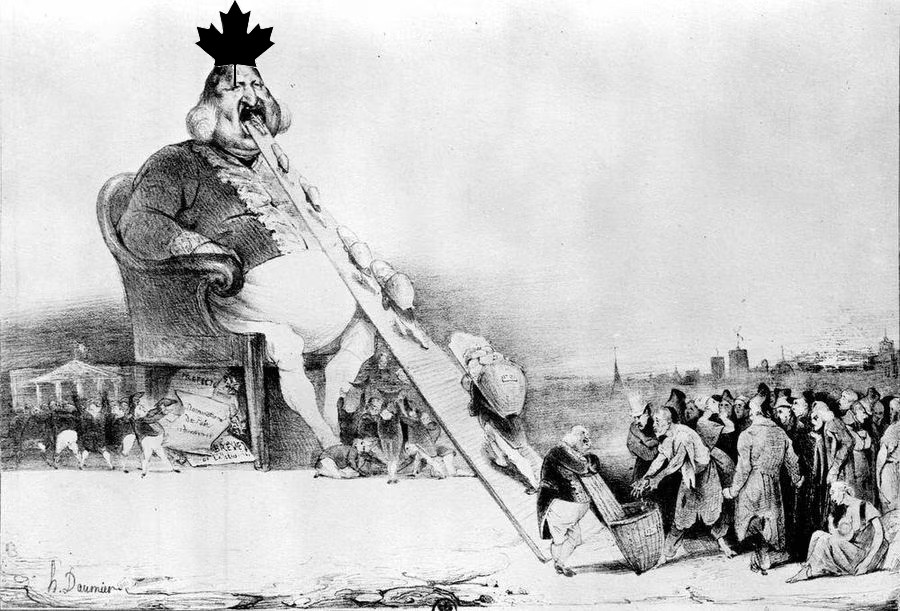
In Canada, our government has repeatedly failed people. Taxes are high and rising. Restrictions on freedom of movement during the pandemic reached an all-time high. Meanwhile, the price of basic necessities like housing and food keeps rising. People’s property and well-being are not protected by the State. Crime has risen throughout Canadian cities and on public transportation, fuelled by police inaction. Everything indicates that the social contract has long been broken, and yet we repeatedly do nothing about it. The Freedom Convoy was quickly and brutally squashed using extraordinary government powers that had never been invoked before.[ii] Bank accounts were frozen by the government, and protestors were arrested without bail. This is even more flagrant when the justice system lets violent repeat offenders out on bail. It was disheartening to see how some Canadians rejoiced when the government cracked down on their fellow citizens. Not only does this show a country divided, but it also shows how some people are easily manipulated by the government and fail to see the bigger picture. It does not matter whether you agree with the Freedom Convoy or not. It should never matter whether you agree with something or not. They have the freedom to protest and the freedom of expression, and it should never matter if you agree with the subject matter of the expression because that negates the entire freedom. The noise could have been dealt with through regular city by-laws on noise and nuisance. The measures the government took to deal with the Freedom Convoy were disproportionate and should have been very worrisome for all Canadians. If a government can so easily freeze people’s bank accounts, money that they earned and was already taxed, there is no telling what the government could do. Are we going to eventually live in a country where if someone disagrees with the government, their money is taken, and they face the risk of hunger, and homelessness? That is undoubtedly what happens in a State that has forgotten its duty to the people, the people it is supposed to represent. A large government, aided by laws and extraordinary powers, forgets that it is meant to serve the people, not the opposite way. A State that is supposed to serve the people should never use its legislative powers to make laws that suppress people’s rights and constantly increases their taxation. A State that is supposed to serve the people should never employ its powers of arrest to punish anyone who disagrees with its policies. A State that is supposed to serve people should never fatten itself off the money of the people while the people starve. That is what bandits and tyrants do.
It is time for the government, and all of us, to remember the nature of our respective roles or risk facing revolutions when people become unhappy.
[i] To read more on social contract theory, see: https://iep.utm.edu/soc-cont/#SH2a
[ii] While the War Measures Act had been previously invoked during wartime and the 1970 October Crisis, the Emergencies Act had only ever been invoked on February 14, 2022, during the Freedom Convoy protest. It is debatable whether the government met the threshold for using the extraordinary powers it did. The final report of the Emergencies Act inquiry found that the federal government had met the threshold to use it. However, that result is open to public scrutiny. Paul Rouleau, the commissioner of the inquiry, was personally selected by Prime Minister Trudeau and was previously involved with Liberal Party leadership campaigns.
 Liberstate